Long Story, Short

Goody Traders

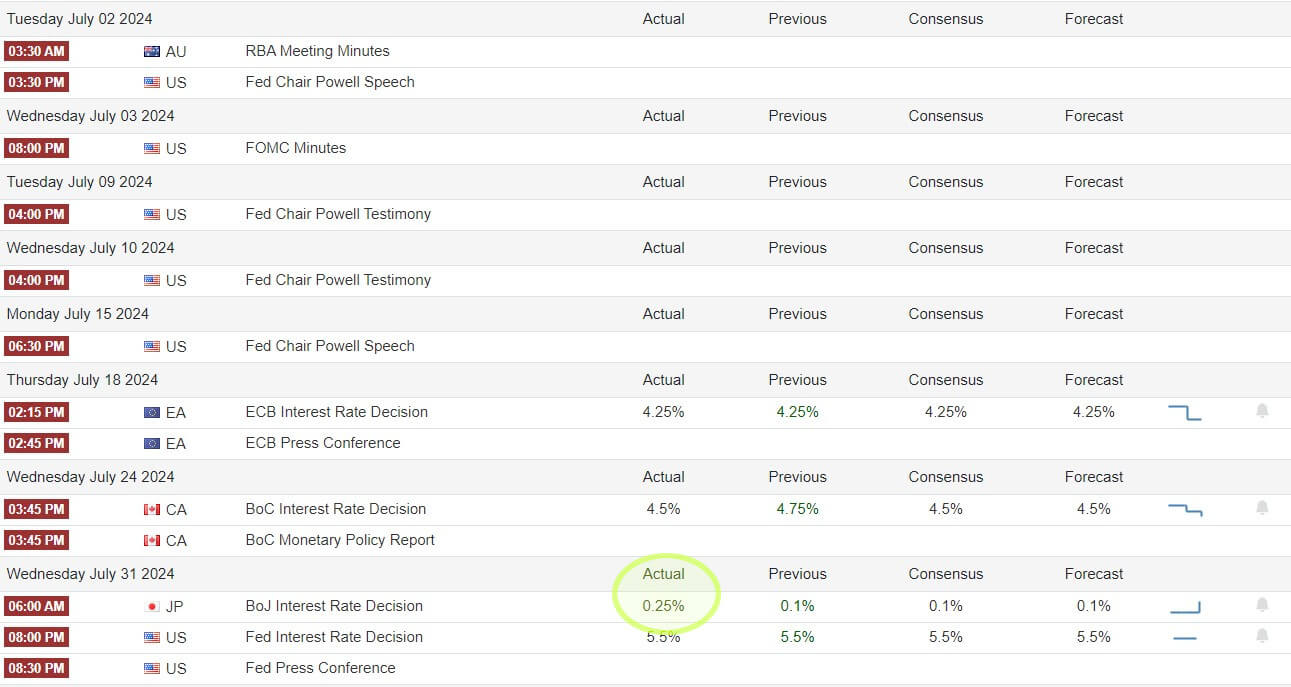
German 18.07.2024, Geldpolitische Entscheidung der EZB (Leitzinssatz: 4,25 % +/- 0,0)
24.07.2024, Geldpolitische Entscheidung der BoC (Leitzinssatz: 4,50 % – 0,25)
31.07.2024, Geldpolitische Entscheidung der BoJ (Leitzinssatz: 0,25 % + 0,15)
31.07.2024, Geldpolitische Entscheidung der FED (Leitzinssatz: 5,50 % +/- 0,0)
01.08.2024, Geldpolitische Entscheidung der BoE (Leitzinssatz: 5,00 % – 0,25)
06.08.2024, Geldpolitische Entscheidung der RBoA (Leitzinssatz: 4,35 % +/- 0,0)
22.08. bis 24.08. Jackson Hole Economic Symposium


1. Geldpolitische Entscheidung der EZB am 18. Juli 2024
Am 18. Juli 2024 entschied sich die Europäische Zentralbank (EZB), ihre Zinssätze unverändert zu lassen, was ihren vorsichtigen Ansatz angesichts der Herausforderungen durch das verlangsamte Wirtschaftswachstum in der Eurozone widerspiegelt. Trotz des anhaltenden Inflationsdrucks wurde die Entscheidung der EZB als ein Gleichgewicht zwischen Inflationskontrolle und Unterstützung der Wirtschaft angesehen. Dieser Schritt verhalf dem Euro zu Stärke, insbesondere gegenüber dem US-Dollar, da die Märkte erwarten, dass die FED in den kommenden Monaten zu vermehrten Zinssenkungen neigen könnte.

2. Zinssenkung der Bank of Canada am 24. Juli 2024
Am 24. Juli 2024 senkte die Bank of Canada (BoC) ihren Leitzins um 25 Basispunkte auf 4,50 %. Diese Entscheidung war durch Bedenken hinsichtlich der Abschwächung der kanadischen Wirtschaft und der negativen Auswirkungen eines starken kanadischen Dollars auf die Exporte motiviert. Die Zinssenkung wurde zwar allgemein erwartet, führte jedoch zu einer kurzen Schwächung des kanadischen Dollars. Die Währung konnte jedoch schnell wieder etwas Boden gutmachen, da der Markt seine Erwartungen hinsichtlich der zukünftigen geldpolitischen Ausrichtung der BoC neu kalibrierte. Das Paar USD/CAD erlebte eine erhöhte Volatilität, da die Händler auf die Zinssenkung und ihre breiteren wirtschaftlichen Auswirkungen reagierten.

3. Zinserhöhung der Bank of Japan am 31. Juli 2024
Die Bank of Japan (BoJ) erhöhte ihren Leitzins am 31. Juli 2024 von 0,10 % auf 0,25 %. Dieser Schritt markierte eine Fortsetzung der allmählichen Abkehr der BoJ von ihrer bisherigen ultralockeren Geldpolitik, die bereits damit begonnen hatte, sich von der negativen Zinsepoche zu verabschieden. Die Entscheidung war auf die steigende inländische Inflation und die Notwendigkeit zurückzuführen, den Yen zu stabilisieren, der deutlich schwächer geworden war. Diese Zinserhöhung wurde weitgehend erwartet, da die jüngsten Wirtschaftsdaten auf eine höhere Inflation hindeuteten. Nach der Ankündigung legte der japanische Yen gegenüber dem US-Dollar deutlich zu, was zu einem starken Rückgang im Exchange USD/JPY führte. Die Entscheidung führte auch zu einer Neubewertung der Carry Trades, was die Marktvolatilität erhöhte.

4. Zinssatzkonstanz der Federal Reserve am 31. Juli 2024
Am 31. Juli 2024 beschloss die Federal Reserve, ihren Leitzinssatz nach einer Reihe von Zinserhöhungen zur Bekämpfung der Inflation, die sich inzwischen bei etwa 2,9 % stabilisiert hat, bei 5,50 % zu belassen. Die Entscheidung, die Zinsen stabil zu halten, wurde allgemein erwartet und spiegelt die vorsichtige Haltung der Fed wider, die jedoch bei Bedarf für künftige Anpassungen offen bleibt. Der US-Dollar schwächte sich nach der Ankündigung weiter ab, da die Spekulationen über mögliche Zinssenkungen in der Zukunft zunahmen. Diese gemäßigte Prognose trug zu einem allgemeinen Rückgang des USD bei, insbesondere gegenüber dem Yen und dem Euro.

5. Zinssenkung der Bank of England am 1. August 2024
Die Bank of England (BoE) senkte ihren Leitzins am 1. August 2024 von 5,25 % auf 5,00 % und begründete dies mit Bedenken hinsichtlich eines verlangsamten Wirtschaftswachstums und eines schwächelnden Arbeitsmarktes. Obwohl die Inflation über dem Zielwert blieb, wurde die Zinssenkung als notwendig erachtet, um die britische Wirtschaft angesichts zunehmender globaler Unsicherheiten zu unterstützen. Das britische Pfund fiel nach der Ankündigung zunächst stark gegenüber dem US-Dollar und dem Euro, konnte jedoch später einige Verluste wieder aufholen, da die Märkte darüber diskutierten, ob diese Senkung ein einmaliges Ereignis sein oder den Beginn eines längeren Lockerungszyklus signalisieren würde. Das GBP/USD-Paar erlebte erhebliche Schwankungen, da die Auswirkungen der Entscheidung der BoE vom Markt verschiedenlich absorbiert wurden.

6. Zinsfestlegung der Reserve Bank of Australia am 6. August 2024
Am 6. August 2024 beschloss die Reserve Bank of Australia (RBA), ihren Leitzins bei 4,35 % zu belassen. Die Entscheidung der RBA spiegelte trotz anhaltender Inflationssorgen einen vorsichtigen Ansatz angesichts gemischter Konjunktursignale wider, insbesondere schwacher Verbraucherausgaben und eines fragilen Immobilienmarkts. Der australische Dollar erlebte nach der Ankündigung nur begrenzte Bewegungen, erholte sich jedoch später aufgrund steigender Rohstoffpreise und einer verbesserten Marktstimmung. Der Exchange AUD/USD blieb relativ stabil, mit kurzen Phasen der Volatilität, während Händler die geldpolitischen Entscheidungen der RBA beurteilten.

Währungspaar Neuster Trend (ab dem 18. July 2024)
USD/JPY Signifikante Abwärtsbewegung, hohe Volatilität
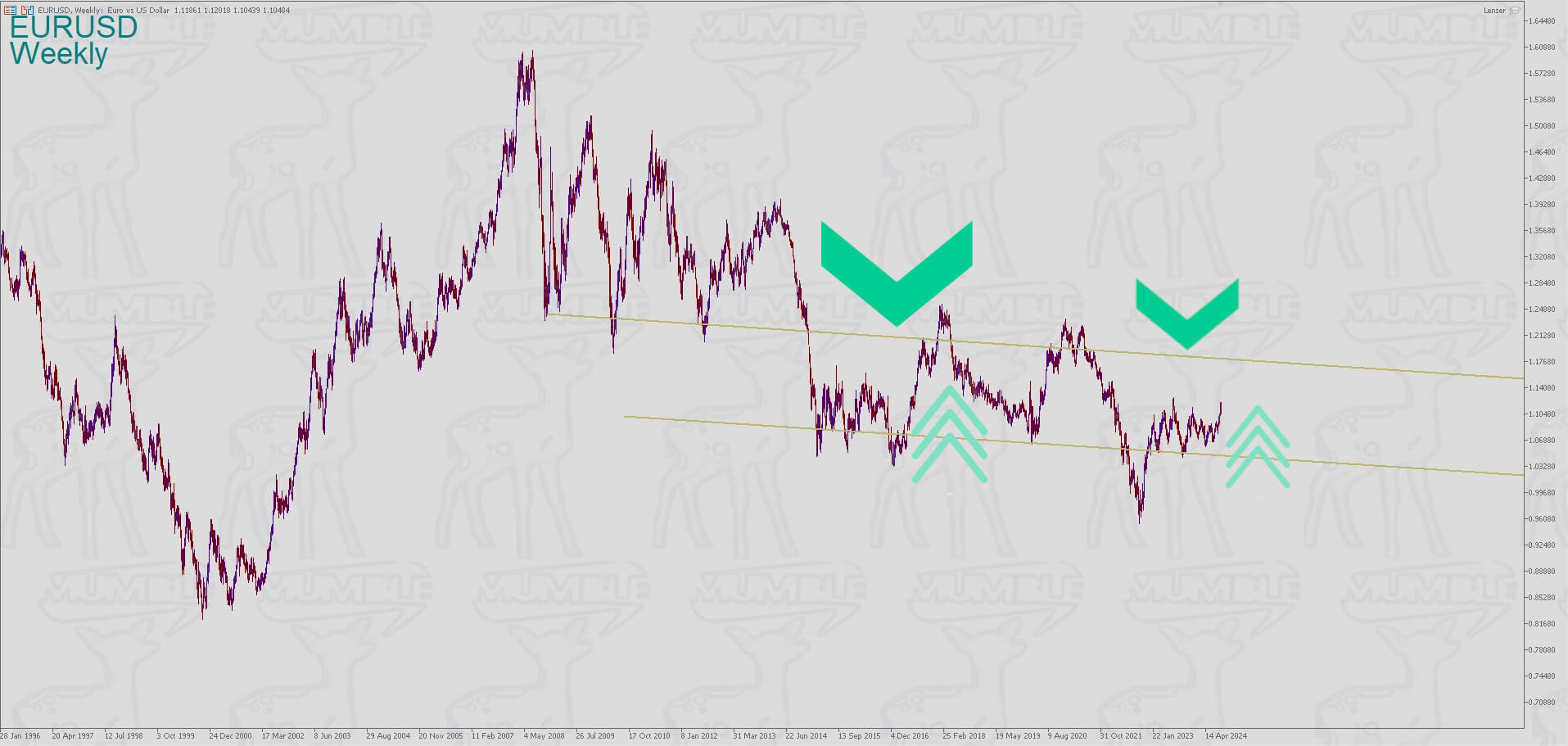
EUR/USD Euro mit Zugewinnen, schwächelder USD
GBP/USD Die Erwartungen wurden übertroffen; allerdings wird von einem rigiden Wachstum ausgegangen
USD/CAD Bullen und Bären gleichauf; warten auf nachlassenden Inflationdruck
AUD/USD An den Inflationserwartungen ausgerichtete Kursbewegungen


World Economic Forum @Jackson Hole, Wyoming
Der Vorsitzende der US-Notenbank, Jerome Powell, erklärte in seiner mit Spannung erwarteten Rede, dass BoTg-b4die Zeit für eine Anpassung der Geldpolitik gekommen ist, was auf ein wachsendes Vertrauen in die Entwicklung der Inflation schließen lässt. Dieser gemäßigte Kurswechsel des Fed-Vorsitzenden wurde von anderen großen Zentralbanken wie der Bank of England und der Europäischen Zentralbank wiederholt.
Während der genaue Zeitpunkt und das Tempo künftiger Zinsanpassungen von den kommenden Wirtschaftsdaten abhängen, besteht unter den politischen Entscheidungsträgern Einigkeit darüber, dass eine schrittweise Lockerung der Geldpolitik jetzt angebracht ist. Dieser Kurswechsel dürfte das Wirtschaftswachstum ankurbeln und den Druck auf Unternehmen und Verbraucher etwas verringern.

Weitere Details und einen Ausblick auf den FX Exchange wie immer für Premium-Mitglieder.


LG Ben&Deniz

Shabbat Shalom
English 07/18/2024, Monetary Policy Decision of the ECB (Key Interest Rate: 4.25% +/- 0.0)
07/24/2024, Monetary Policy Decision of the BoC (Key Interest Rate: 4.50% – 0.25)
07/31/2024, Monetary Policy Decision of the BoJ (Key Interest Rate: 0.25% + 0.15)
07/31/2024, Monetary Policy Decision of the FED (Key Interest Rate: 5.50% +/- 0.0)
08/01/2024, Monetary Policy Decision of the BoE (Key Interest Rate: 5.00% – 0.25)
08/06/2024, Monetary Policy Decision of the RBoA (Key Interest Rate: 4.35% +/- 0.0)
08/22nd to 08/24th Jackson Hole Economic Symposium


1. ECB Monetary Policy Decision on 18 July 2024
On 18 July 2024, the European Central Bank (ECB) opted to keep its interest rates unchanged, reflecting its cautious approach amid the challenges posed by slowing economic growth in the Eurozone. Despite persistent inflationary pressures, the ECB’s decision was seen as a balance between controlling inflation and supporting the economy. This move helped the Euro gain strength, particularly against the US Dollar, as markets anticipated that the FED might lean towards a more dovish stance in the coming months.

2. Bank of Canada Rate Cut on 24 July 2024
On 24 July 2024, the Bank of Canada (BoC) reduced its key interest rate by 25 basis points to 4.50%. This decision was motivated by concerns about the Canadian economy’s slowdown and the negative impact of a strong Canadian Dollar on exports. The rate cut, while widely anticipated, resulted in a brief weakening of the Canadian Dollar. However, the currency quickly regained some ground as the market recalibrated its expectations for the BoC’s future monetary policy direction. The USD/CAD pair experienced heightened volatility as traders responded to the rate cut and its broader economic implications.

3. Bank of Japan’s Rate Hike on 31 July 2024
The Bank of Japan (BoJ) increased its benchmark interest rate from 0.10% to 0.25% on 31 July 2024. This move marked a continuation of the BoJ’s gradual shift away from its previous ultra-loose monetary policy, which had already begun with earlier rate hikes moving out of negative territory. The decision was driven by rising domestic inflation and the need to stabilize the Yen, which had been weakening significantly. This rate hike was largely anticipated, given the recent economic data pointing to higher inflation. Following the announcement, the Japanese Yen strengthened considerably against the US Dollar, causing the USD/JPY pair to decline sharply. The decision also led to a reevaluation of carry trades, increasing market volatility.

4. Federal Reserve’s Rate Hold on 31 July 2024
On 31 July 2024, the Federal Reserve decided to maintain its key interest rate at 5.50%, following a series of rate hikes aimed at combating inflation, which has now stabilized around 2.9%. The decision to hold rates steady was widely expected, reflecting the Fed’s cautious stance while remaining open to future adjustments if necessary. The US Dollar continued to weaken after the announcement, as speculation grew over potential rate cuts in the future. This dovish outlook contributed to a broad decline in the USD, particularly against the Yen and the Euro.

5. Bank of England’s Rate Cut on 1 August 2024
The Bank of England (BoE) cut its benchmark interest rate from 5.25% to 5.00% on 1 August 2024, citing concerns about slowing economic growth and a softening labor market. Despite inflation remaining above target, the rate cut was deemed necessary to support the UK economy amid rising global uncertainties. The British Pound initially fell sharply against the US Dollar and the Euro following the announcement but later recovered some losses as markets debated whether this cut would be a one-off event or signal the beginning of a more prolonged easing cycle. The GBP/USD pair experienced significant fluctuations as the implications of the BoE’s decision were absorbed by the market.

6. Reserve Bank of Australia’s Rate Hold on 6 August 2024
On 6 August 2024, the Reserve Bank of Australia (RBA) decided to keep its cash rate at 4.35%. The RBA’s decision reflected a cautious approach amid mixed economic signals, particularly weak consumer spending and a fragile housing market, despite ongoing inflation concerns. The Australian Dollar saw limited immediate movement following the announcement, but it later strengthened due to rising commodity prices and improved market sentiment. The AUD/USD pair remained relatively stable, with brief periods of volatility as traders assessed the RBA’s policy outlook.

Currency Pair Latest Trends (Post-18 July 2024)
USD/JPY Significant decline, high volatility
EUR/USD Strengthened Euro, weak USD
GBP/USD Exceeded expectations; underlying surveys suggest slower economic momentum
USD/CAD Remains restrictive until inflation risks diminish; MPC monitoring closely
AUD/USD Prepared to adjust policy based on upcoming economic data and forecasts


World Economic Forum @Jackson Hole, Wyoming
Federal Reserve Chair Jerome Powell, in his highly anticipated speech, declared that BoTg-b4the time has come for policy to adjust, indicating a growing confidence in the trajectory of inflation. This dovish pivot from the Fed chair was echoed by other major central banks, such as the Bank of England and the European Central Bank.
While the exact timing and pace of future rate adjustments will depend on incoming economic data, the consensus among policymakers is that a gradual easing of monetary policy is now appropriate. This shift is expected to provide a boost to economic growth and alleviate some of the pressures on businesses and consumers.

More details and my outlook on the FX Exchange as always for Premium Members.

Sincerely Yours, Ben&Deniz

Economic Calendar July
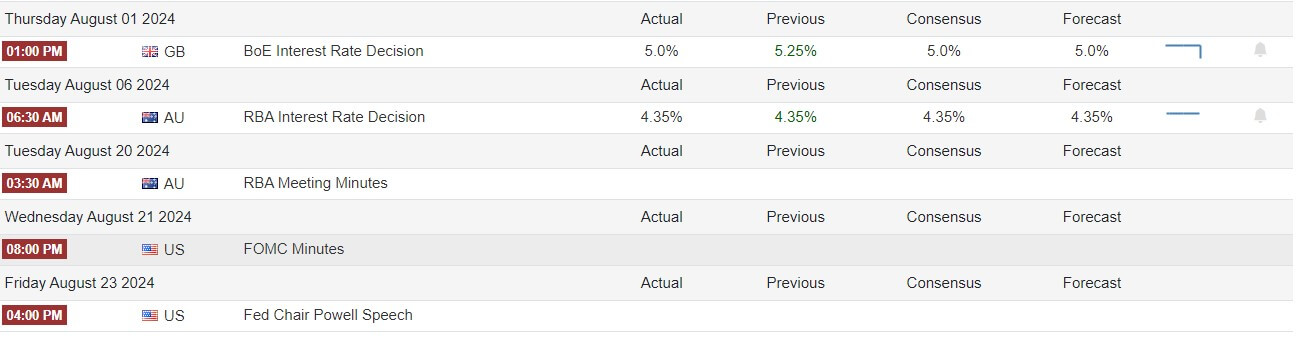
Economic Calendar August
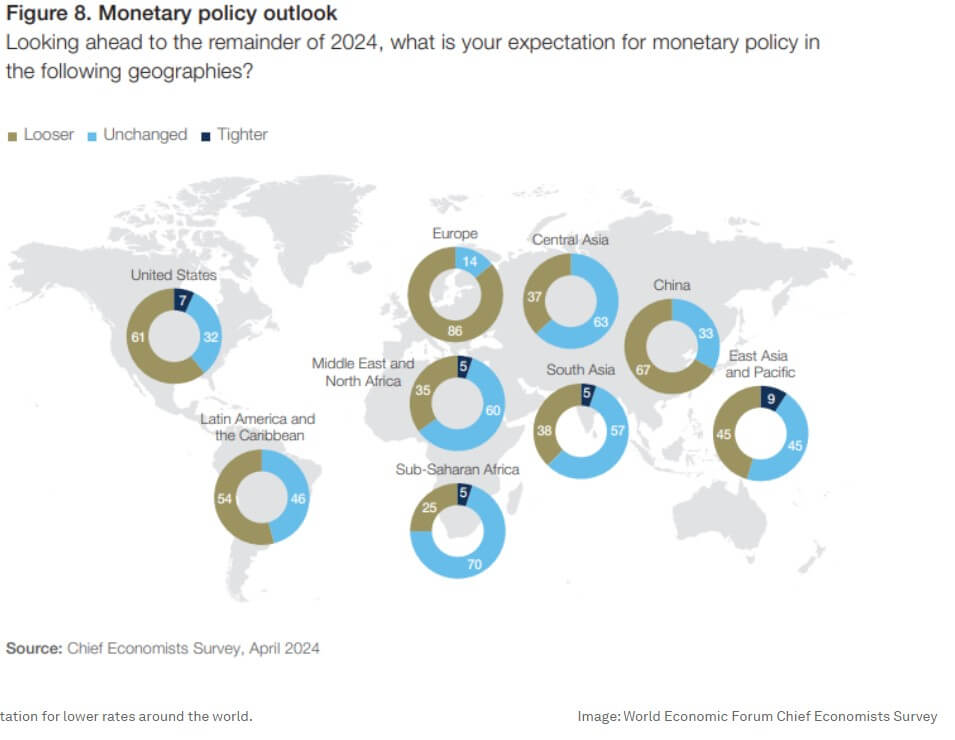
WEF Rates Outlook
World Economic Forum Rates Outlook
EURUSD Weekly Chart
EURUSD Weekly Chart
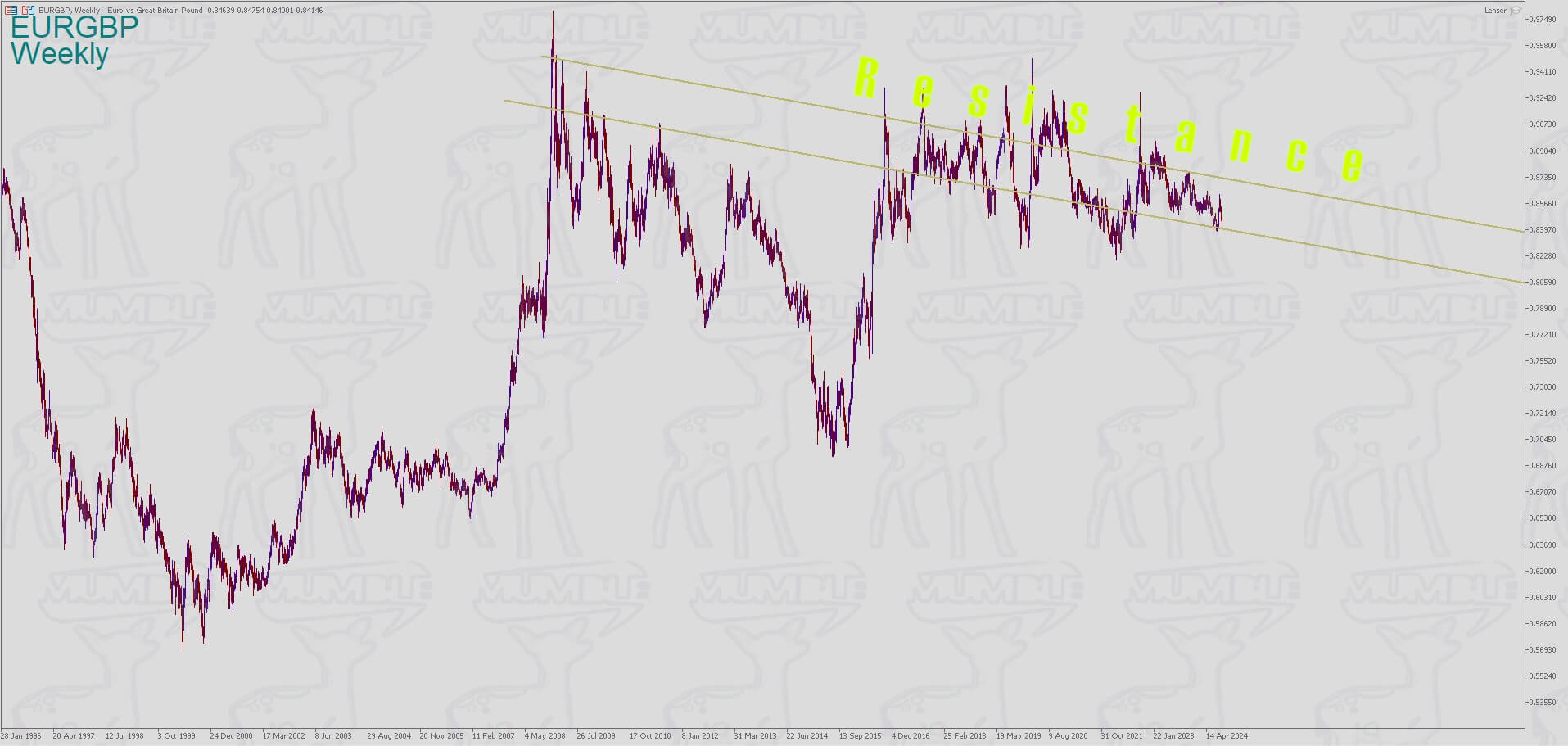
EURGBP Weekly Chart
EURGBP Weekly Chart
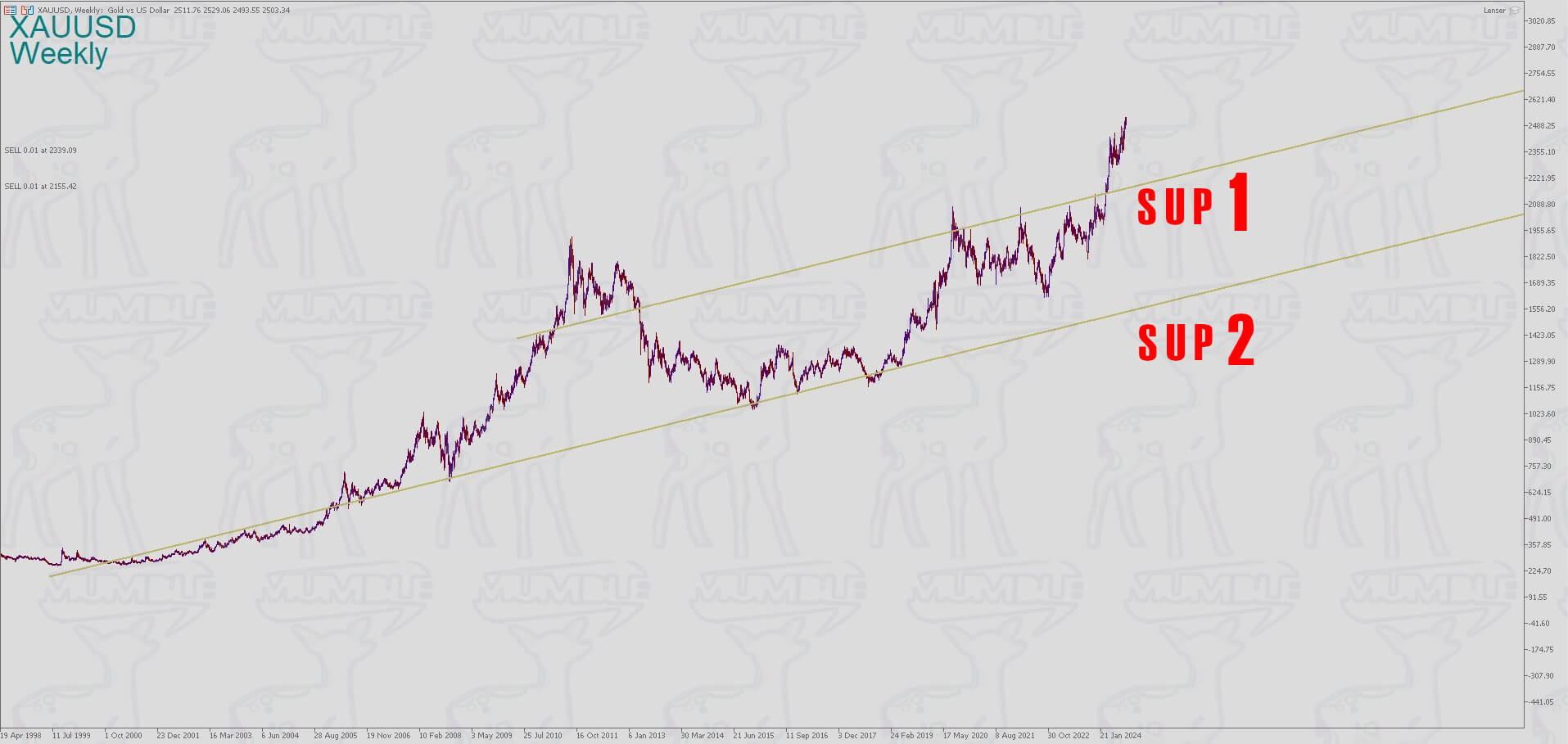
Gold Weekly Chart
Gold Weekly Chart
ECB Governing Council Press Conference – 18 July 2024
BoC Monetary Policy Report in brief – 24 July 2024
Bank of Canada Press Conference – 24 July 2024
FOMC Press Conference July 31, 2024
Bank of England Press Conference, August 01 2024
Reserve Bank of Australia Monetary Policy Decision – 06 August 2024
Fed Rate Cuts Confirmed at Jackson Hole
Broadcasted by: ClearValue Tax

Externe Quellen/Links
URL-Link Beschreibung
ecb.europa.eu – Combined decisions and statement July 18, 2024 (PDF)
bankofcanada.ca – Press Conference Opening Statement July 24, 2024
bankofcanada.ca – Monetary Policy Report July 24, 2024 (PDF)
NHK WORLD JAPAN NEWS – Bank of Japan hikes rates for 2nd time this year July 31, 2024
boj.or.jp – Decisions at the July 2024 Monetary Policy Meeting (PDF)
boj.or.jp – Outlook for Economic Activity and Prices July 2024 (PDF)
federalreserve.gov – Federal Reserve issues FOMC statement July 31, 2024 (PDF)
federalreserve.gov – Transcript of Chair Powell’s Press Conference July 31, 2024 (PDF)
bankofengland.co.uk – Monetary Policy Summary, August 01 2024 (PDF)
bankofengland.co.uk – Monetary Policy Report, August 2024 (PDF)
rba.gov.au – Monetary Policy Decision 06 August, 2024
rba.gov.au – Statement on Monetary Policy 06 August, 2024 (PDF)
weforum.org – „The time has come for policy to adjust.“

Europe: Boom or Flop?

Europe: Boom or Flop?

2024-06-09 15:00:39 UTC+1

Guten Tag

German 05.06.2024, Geldpolitischer Beschluss der BoC (Leitzinssatz: 4.75% -0.25).
06.06.2024, Geldpolitischer Beschluss der EZB (Leitzinssatz: 4.25% -0.25).


Die Bank of Canada hat ihr Ziel für den Übernachtzins auf 4,75 % gesenkt, wobei der Bankzinssatz bei 5 % und der Einlagenzinssatz bei 4,75 % liegt. Die Bank setzt ihre Politik der Bilanznormalisierung fort.

Schlüsseldaten Wert
Übernachtzins Gesenkt auf 4,75%
Bankzinssatz 5%
Einlagenzinssatz 4,75%
Wachstum der Weltwirtschaft (Q1 2024) ~3%
US-Wirtschaftswachstum Langsamer als erwartet
Aktivität im Euroraum Gestiegen im Q1 2024
Stärke der chinesischen Wirtschaft Getrieben durch Exporte und industrielle Produktion
Kanadas BIP-Wachstum (Q1 2024) 1,7%
Konsumwachstum in Kanada ~3%
VPI-Inflation (April) Gesunken auf 2,7%

Die Weltwirtschaft wuchs im ersten Quartal 2024 um etwa 3 %, was weitgehend der Projektion im April-Monetary Policy Report (MPR) der Bank entspricht. Die US-Wirtschaft wuchs langsamer als erwartet aufgrund schwacher Exporte und Lagerbestände, während das Wachstum der privaten Inlandsnachfrage nachließ. Die Aktivität im Euroraum nahm zu, und Chinas Wirtschaft war stärker, getrieben durch Exporte und industrielle Produktion, obwohl die Inlandsnachfrage schwach blieb. Die Inflation in den meisten fortgeschrittenen Volkswirtschaften nimmt ab, wobei die Ölpreise und die Finanzbedingungen den MPR-Annahmen nahekommen.

In Kanada nahm das Wirtschaftswachstum im ersten Quartal 2024 um 1,7 % wieder zu, langsamer als prognostiziert, aufgrund schwächerer Lagerinvestitionen. Das Konsumwachstum lag bei etwa 3 %, und sowohl die Unternehmensinvestitionen als auch die Wohnungsaktivität nahmen zu. Der Arbeitsmarkt zeigte ein langsameres Beschäftigungswachstum im Vergleich zur erwerbsfähigen Bevölkerung, und der Lohndruck nimmt allmählich ab. Die VPI-Inflation sank im April auf 2,7 %, und die bevorzugten Kerninflationsmaße der Bank gingen ebenfalls zurück. Die Entscheidung des Zentralbankvorstandes, den Leitzins um 25 Basispunkte zu senken, spiegelt ein erhöhtes Vertrauen wider, dass die Inflation auf das Ziel von 2 % zusteuern wird, obwohl Risiken bestehen. Der Vorstand überwacht weiterhin die Kerninflation, das Gleichgewicht zwischen Angebot und Nachfrage, die Inflationserwartungen, das Lohnwachstum und das Preissetzungsverhalten der Unternehmen.

Der EZB-Rat beschloss am 6. Juni, die drei Leitzinsen der EZB um 25 Basispunkte zu senken. Diese Entscheidung folgt einer aktualisierten Einschätzung der Inflationsaussichten, der Dynamik der zugrunde liegenden Inflation und der Effektivität der geldpolitischen Transmission. Seit der Sitzung des EZB-Rats im September 2023 ist die Inflation um mehr als 2,5 Prozentpunkte gesunken, und die Inflationsaussichten haben sich deutlich verbessert. Die zugrunde liegende Inflation hat nachgelassen, und die Inflationserwartungen sind über alle Horizonte hinweg gesunken. Die restriktive Geldpolitik hat erheblich zur Senkung der Inflation beigetragen, indem sie die Nachfrage gedämpft und die Erwartungen reduziert hat.

Schlüsseldaten Wert
EZB-Zinssätze Um 25 Basispunkte gesenkt
Hauptrefinanzierungsgeschäfte 4,25%
Spitzenrefinanzierungsfazilität 4,50%
Einlagefazilität 3,75%
Inflationsprognosen:
Gesamtinflation 2,5 % (2024), 2,2 % (2025), 1,9 % (2026)
Kerninflation (ohne Energie und Lebensmittel) 2,8 % (2024), 2,2 % (2025), 2,0 % (2026)
Wirtschaftswachstum 0,9 % (2024), 1,4 % (2025), 1,6 % (2026)
PEPP-Reduktionen €7,5 Milliarden pro Monat im zweiten Halbjahr
APP-Portfolio Sinkt vorhersehbar, da Wiederanlagen gestoppt wurden

Trotz der Fortschritte bleibt der heimische Preisdruck aufgrund des erhöhten Lohnwachstums stark, und die Inflation wird wahrscheinlich bis ins nächste Jahr über dem Zielwert bleiben. Die Projektionen des Eurosystems für die Gesamt- und Kerninflation wurden für 2024 und 2025 nach oben revidiert. Die Gesamtinflation wird nun durchschnittlich 2,5 % im Jahr 2024, 2,2 % im Jahr 2025 und 1,9 % im Jahr 2026 betragen. Für die Inflation ohne Energie und Lebensmittel prognostiziert das Eurosystem 2,8 % im Jahr 2024, 2,2 % im Jahr 2025 und 2,0 % im Jahr 2026. Das Wirtschaftswachstum wird voraussichtlich auf 0,9 % im Jahr 2024, 1,4 % im Jahr 2025 und 1,6 % im Jahr 2026 steigen.

Der EZB-Rat ist entschlossen, sicherzustellen, dass die Inflation in einem angemessenen Zeitraum auf das mittelfristige Ziel von 2 % zurückkehrt. Er wird die restriktiven Zinssätze so lange wie nötig beibehalten und dabei datenabhängig und von Sitzung zu Sitzung über das angemessene Niveau und die Dauer der Beschränkung entscheiden. Zinsentscheidungen werden auf der Grundlage der Inflationsaussichten, der wirtschaftlichen und finanziellen Daten, der zugrunde liegenden Inflationsdynamik und der geldpolitischen Transmission getroffen.

Darüber hinaus wird der EZB-Rat die Bestände des Eurosystems an Wertpapieren im Rahmen des Pandemie-Notfallkaufprogramms (PEPP) im zweiten Halbjahr um durchschnittlich 7,5 Milliarden Euro pro Monat reduzieren. Das APP-Portfolio sinkt planmäßig, da das Eurosystem die Hauptfälligkeiten auslaufender Wertpapiere nicht mehr wieder anlegt. Wiederanlagen im Rahmen des PEPP werden bis Ende Juni 2024 fortgesetzt, mit einer Reduktion um 7,5 Milliarden Euro pro Monat im zweiten Halbjahr, und die Wiederanlagen sollen Ende 2024 eingestellt werden. Flexibilität bei den Wiederanlagen von PEPP-Rückzahlungen wird beibehalten, um Risiken für den geldpolitischen Transmissionsmechanismus im Zusammenhang mit der Pandemie zu begegnen.

Weitere Details und einen Ausblick auf den FX Exchange wie immer für Premium-Mitglieder.

LG Ben

Goody Traders

English 06/05/2024, Monetary Policy Decision of the BoC (Key Interest Rate: 4.75% -0.25).
06/06/2024, Monetary Policy Decision of the ECB (Key Interest Rate: 4.25% -0.25).


The Bank of Canada reduced its target for the overnight rate to 4.75%, with the Bank Rate at 5% and the deposit rate at 4.75%. The Bank is continuing its policy of balance sheet normalization.

Key Data Value
Overnight Rate Reduced to 4.75%
Bank Rate 5%
Deposit Rate 4.75%
Global Economy Growth (Q1 2024) ~3%
U.S. Economic Expansion Slower than expected
Euro Area Activity Increased in Q1 2024
China’s Economic Strength Driven by exports and industrial production
Canada GDP Growth (Q1 2024) 1.7%
Consumption Growth in Canada ~3%
CPI Inflation (April) Eased to 2.7%

The global economy grew by about 3% in the first quarter of 2024, broadly in line with the Bank’s April Monetary Policy Report (MPR) projection. The U.S. economy expanded more slowly than expected due to weak exports and inventories, while growth in private domestic demand eased. The euro area saw increased activity, and China’s economy was stronger, driven by exports and industrial production, though domestic demand remained weak. Inflation in most advanced economies is easing, with oil prices and financial conditions close to MPR assumptions.

In Canada, economic growth resumed in the first quarter of 2024 at 1.7%, slower than forecast, due to weaker inventory investment. Consumption growth was about 3%, with increases in business investment and housing activity. The labor market showed slower employment growth relative to the working-age population, and wage pressures are gradually moderating. CPI inflation eased to 2.7% in April, with core inflation measures also slowing. The Governing Council’s decision to reduce the policy interest rate by 25 basis points reflects increased confidence that inflation will move towards the 2% target, though risks remain. The Council continues to monitor core inflation, demand and supply balance, inflation expectations, wage growth, and corporate pricing behavior.

The Governing Council of the ECB decided on June 6th to lower the three key ECB interest rates by 25 basis points. This decision follows an updated assessment of the inflation outlook, underlying inflation dynamics, and the effectiveness of monetary policy transmission. Since September 2023, inflation has decreased by more than 2.5 percentage points, and the inflation outlook has improved markedly. Underlying inflation has eased, and inflation expectations have declined across all horizons. Restrictive monetary policy has significantly contributed to reducing inflation by dampening demand and anchoring expectations.

Key Data Value
ECB Interest Rates Lowered by 25 basis points
Main Refinancing Operations 4.25%
Marginal Lending Facility 4.50%
Deposit Facility 3.75%
Inflation Forecasts:
Headline Inflation 2.5% (2024), 2.2% (2025), 1.9% (2026)
Core Inflation (excluding energy and food) 2.8% (2024), 2.2% (2025), 2.0% (2026)
Economic Growth 0.9% (2024), 1.4% (2025), 1.6% (2026)
PEPP Reductions €7.5 billion per month over the second half of the year
APP Portfolio Declining predictably as reinvestments stop

Despite progress, domestic price pressures remain strong due to elevated wage growth, with inflation likely to stay above target into next year. Eurosystem staff projections have revised up headline and core inflation for 2024 and 2025, with headline inflation expected to average 2.5% in 2024, 2.2% in 2025, and 1.9% in 2026. For inflation excluding energy and food, staff project averages of 2.8% in 2024, 2.2% in 2025, and 2.0% in 2026. Economic growth is forecasted to rise to 0.9% in 2024, 1.4% in 2025, and 1.6% in 2026.

The Governing Council is committed to ensuring inflation returns to its 2% medium-term target. It will maintain restrictive policy rates as necessary, following a data-dependent and meeting-by-meeting approach. Interest rate decisions will be based on assessments of the inflation outlook, economic and financial data, underlying inflation dynamics, and monetary policy transmission.

Additionally, the Governing Council will reduce the Eurosystem’s holdings of securities under the pandemic emergency purchase programme (PEPP) by €7.5 billion per month on average over the second half of the year. The APP portfolio is declining predictably as the Eurosystem no longer reinvests principal payments from maturing securities. Reinvestments under the PEPP will continue until the end of June 2024, with reductions of €7.5 billion per month over the second half of the year, and reinvestments are set to discontinue at the end of 2024. Flexibility in reinvesting redemptions from the PEPP portfolio will be maintained to counter risks to the monetary policy transmission mechanism related to the pandemic.

More details and my outlook on the FX Exchange as always for Premium Members.

Sincerely Yours, Ben

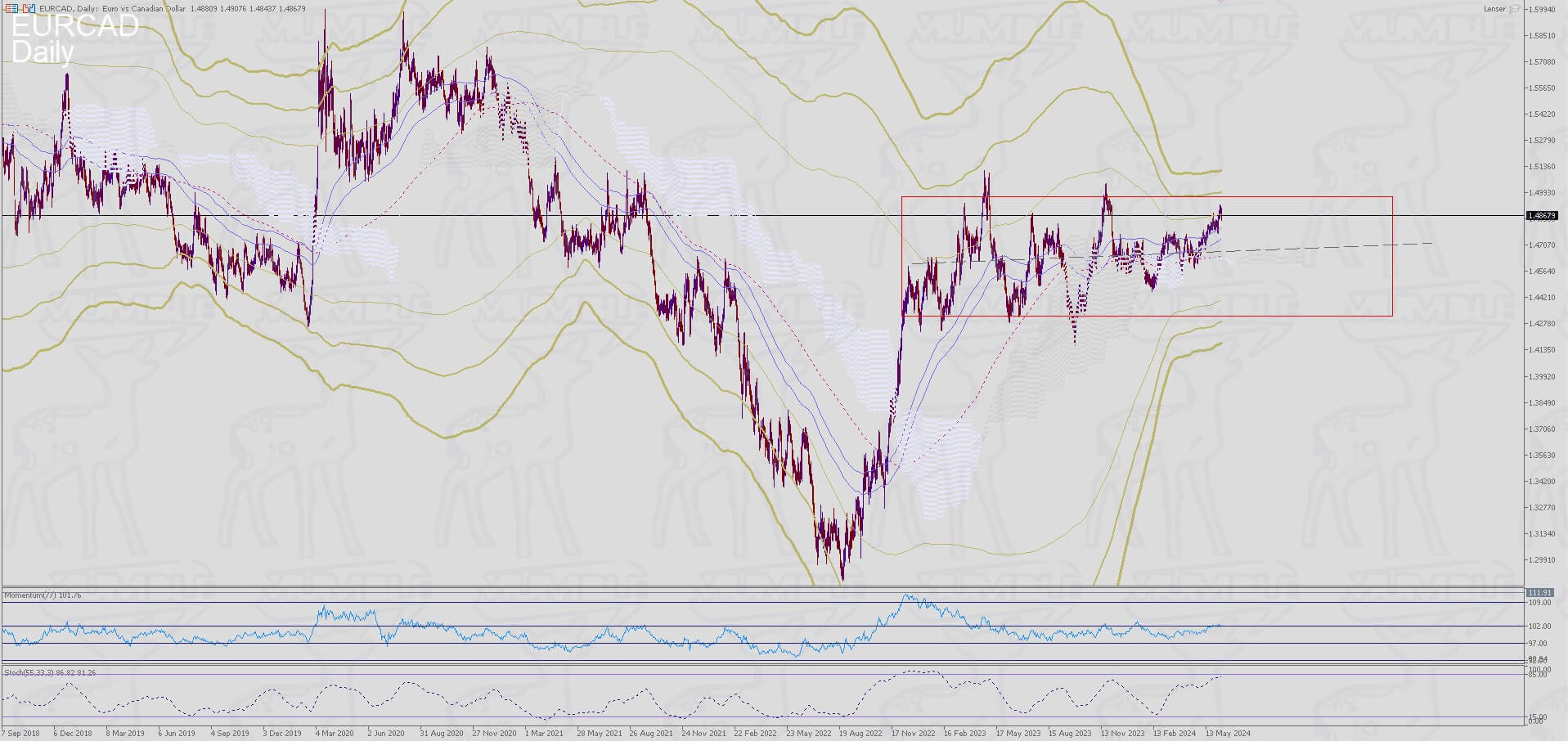
EURCAD Daily Chart
EURCAD Daily-Chart
EURCAD M30 Chart
EURCAD M30-Chart
S&P500 Daily Chart
S&P500 Daily Chart
BoC Press Conference, June 5 2024
Media availability on June 5, 2024 / Point de presse le 5 juin 2024
ECB Governing Council Press Conference – 6 June 2024
Are the EU’s new members REALLY catching up?, 30 May 2024
Into Europe

Externe Quellen/Links

URL-Link Beschreibung
bankofcanada.ca – BoC reduces policy rate by 25 basis points June 05, 2024
bankofcanada.ca – BoC Press Conference Opening Statement June 05, 2024
ecb.europa.eu – ECB monetary policy decisions and statement June 05, 2024 (PDF)
Lukas Spielberger – The politicisation of the European Central Bank February 14, 2022 (PDF)

The sun rises in the East

The sun rises in the East

2024-04-28 13:02:53 UTC+1

Guten Tag

German 05.04.2024, US Arbeitslosenzahlen (März 2024 m/m: 3.8% -0.1%).
05.04.2024, US Lohnentwicklung (Stundenlohn Mittel y/y: 4.1% -0.2%).
09.04.2024, BoJ Vorsitzender Ueda, Erklärung vor dem Finanzausschuss des ‚House of Councilors‘.
10.04.2024, US Konsumenten Preisindex (CPI, s.a.) (1982-1984=100, 312.23 points).
10.04.2024, Geldpolitischer Beschluss der Bank of Canada (Leitzinssatz: 5.00% +/- 0.0).
10.04.2024, US FED Protokoll des Federal Open Market Committee (19.-20. März 2024).
11.04.2024, Geldpolitischer Beschluss der Europäischen Zentralbank (Leitzinssatz: 4.5% +/- 0.0).
16.04.2024, Rede zwischen BoC Tiff Macklem und FED Jerome Powell (Wilson Center’s Washington Forum).
18.04.2024, BoJ Exekutivdirektor SHIMIZU Seiichi, Grundsatzrede (ISDA).
26.04.2024, Geldpolitischer Beschluss der Bank of Japan (Leitzinssatz: 0.10% +/- 0.0).


Halbjährlicher Bericht der Bank von Japan durch den Vorsitzenden UEDA Kazuo am 9. April, 2024:
Der halbjährliche Bericht der Bank von Japan bietet Einblicke in die jüngsten wirtschaftlichen und finanziellen Entwicklungen in Japan und skizziert den Ansatz der Bank in Bezug auf die Geldpolitik. Die japanische Wirtschaft befindet sich auf einem moderaten Erholungspfad, wobei die Unternehmensgewinne und Investitionen im Geschäftsumfeld positiv tendieren. Allerdings gibt es noch einige Schwächen, wie etwa stagnierende Exporte und sporadische Störungen im privaten Konsum. Der Verbraucherpreisindex (CPI) verzeichnet einen jährlichen Anstieg von 2,5 bis 3,0 Prozent, der durch die anhaltenden Effekte früherer Kostensteigerungen getrieben wird. Die Bank erwartet, dass sich die zugrunde liegende CPI-Inflation allmählich dem Preisstabilitätsziel von 2 Prozent bis zum Ende des Haushaltsjahres 2024 annähert. Das Finanzsystem bleibt robust, wobei japanische Finanzinstitute eine starke Kapitalbasis beibehalten. Die Bank hat ihren geldpolitischen Rahmen geändert, wobei der Fokus auf dem kurzfristigen Zinssatz liegt, mit einem Zielbereich von 0 bis 0,1 Prozent. Dies zeigt, dass die bisherige quantitative und qualitative Lockerung (QQE) und die Steuerung der Zinskurve ihren Zweck erfüllt haben. Angesichts des aktuellen wirtschaftlichen Ausblicks plant die Bank, die lockeren Finanzbedingungen für die absehbare Zukunft beizubehalten und ihre Politik bei Bedarf anzupassen, um eine nachhaltige und stabile Preisstabilität zu gewährleisten.

Etwas später, am 18. April hielt der BoJ Exekutivdirektor, SHIMIZU Seiichi, eine Grundsatzrede auf der 38. Jahreshauptversammlung der ‚International Swaps and Derivatives Association‘ (ISDA). Er referierte hier über die LIBOR Reformen. Eine Zusammenfassung soll an dieser Stelle angebracht sein, um die Wichtigkeit dieser Finanzmarkt-Reform zu unterstreichen:
Der Übergang vom LIBOR, dem einst dominierenden Zinsreferenzsatz, ist eine wichtige Initiative zur Verbesserung der Integrität und Robustheit der Finanzmärkte. Nach weit verbreiteten Bedenken hinsichtlich der Glaubwürdigkeit des LIBOR aufgrund von Manipulationsversuchen unternahmen internationale Gremien umfassende Anstrengungen, um alternative Referenzsätze zu identifizieren und die Umstellung zu ermöglichen. 2013 veröffentlichte die International Organization of Securities Commissions (IOSCO) einen Bericht, der die gewünschten Eigenschaften von Zinsreferenzsätzen darlegte und eine glaubwürdige Governance sowie eine transaktionsbasierte Berechnung gegenüber Expertenschätzungen empfahl. Der Financial Stability Board (FSB) folgte mit einem Bericht von 2014, der die Reform bestehender IBORs und die Einführung von risikofreien Zinsen befürwortete und einen Mehrfachansatz empfahl, um Flexibilität für verschiedene Gerichtsbarkeiten und Transaktionstypen zu ermöglichen.
Japans LIBOR-Reform entspricht diesen internationalen Empfehlungen und umfasst die Umstellung auf Referenzsätze wie den Tokyo Overnight Average Rate (TONA), den reformierten Tokyo Interbank Offered Rate (TIBOR) und den Tokyo Term Risk Free Rate (TORF). Diese Veränderung hat erhebliche Auswirkungen auf Zinsswaps, da die meisten bestehenden Verträge nun TONA als Referenz verwenden. Der reibungslose Übergang vom LIBOR, der weitgehend mit der Einstellung der Veröffentlichung des USD-LIBOR im Juni abgeschlossen war, wurde durch die Zusammenarbeit zwischen Finanzinstituten, Marktteilnehmern und nationalen Arbeitsgruppen erleichtert. Diese Gruppen, unterstützt von der Bank of Japan und internationalen Organisationen wie der ISDA, spielten eine entscheidende Rolle bei der Koordinierung der Umstellungsstrategien und der Gewährleistung der Einhaltung der IOSCO-Prinzipien. Trotz des Erfolgs bei der Umstellung vom LIBOR bleiben einige Herausforderungen bestehen, insbesondere die nachhaltige Nutzung alternativer Referenzsätze und die fortlaufende Umstellung vom Euroyen TIBOR, dessen Veröffentlichung am Ende des Jahres eingestellt wird.

Zum 5. April wurde der Abstand zwischen Lohnwachstum und Arbeitslosenzahlen deutlich negativer. Der Wert liegt jetzt bei 1,08, verglichen mit 1,31 im Vorjahr, was eine Verschlechterung des Arbeitsmarktes um 23% bedeutet. Das bedeutet, wenn die Löhne sinken, während die Arbeitslosigkeit steigt, bewegt sich der Arbeitsmarkt in die falsche Richtung.

Am 10. April lag die US-Kerninflation, saisonal angepasst, bei 312,23 Punkten. Wenn man das Lohnwachstum mit der Inflation vergleicht, erhält man ein Gefühl dafür, was „reale“ Inflation für die Verbraucher bedeutet. Um zu berechnen, wie sich Ihre Löhne seit 1982-1984 verändert haben, wird diese Periode auf 100 Punkte festgelegt. Wenn Ihr Einkommen damals €17.500 war und es jetzt €35.000 beträgt, würden Sie (100 x 35.000) / 17.500 = 200 rechnen. Vergleicht man Ihr Lohnwachstum mit der Inflation, bedeutet das jedoch, dass Ihr Einkommen in realen Zahlen um 36% gesunken ist.

Die Protokolle der Sitzung des Federal Open Market Committee vom 19.-20. März gaben Aufschluss darüber, warum der Leitzins am 10. April festgelegt wurde. Die Rede des Vorsitzenden der Federal Reserve, Jerome Powell, am Wilson Center am 16. April war besonders interessant, weil erwartet wurde, dass er sich zu den jüngsten US-Kerninflationsdaten äußern würde.

Insgesamt erwartet der Markt nun keine schnelle Zinssenkung mehr, und eine längere Phase hoher Zinssätze scheint wahrscheinlicher zu sein. Zusammen mit der Entscheidung der japanischen Zentralbank, den Leitzins bei 0,1% zu belassen, fiel der Yen am 26. April um -1,72% gegenüber dem US-Dollar auf 158,3.

Auch die Europäische Zentralbank veröffentlichte am 11. April, ihren Leitzins bei 4,5% zu belassen.

Weitere Details und einen Ausblick auf den FX Exchange wie immer für Premium-Mitglieder.

LG Ben

Goody Traders

English 04/05/2024, US unemployment figures (March 2024 m/m: 3.8% -0.1%).
04/05/2024, US wage development (hourly wage average y/y: 4.1% -0.2%).
04/09/2024, BoJ Chairman Ueda, statement to the Finance Committee of the ‚House of Councilors‘.
04/10/2024, US Consumer Price Index (CPI, s.a.) (1982-1984=100, 312.23 points).
04/10/2024, Monetary policy decision of the Bank of Canada (key interest rate: 5.00% +/- 0.0).
04/10/2024, US FED Minutes of the Federal Open Market Committee (March 19-20, 2024).
04/11/2024, Monetary policy decision of the European Central Bank (key interest rate: 4.5% +/- 0.0).
04/16/2024, Speech between BoC Tiff Macklem and FED Jerome Powell (Wilson Center’s Washington Forum).
04/18/2024, BoJ Executive Director SHIMIZU Seiichi, keynote speech (ISDA).
04/26/2024, Monetary policy decision of the Bank of Japan (key interest rate: 0.10% +/- 0.0).

Bank of Japan Semi-Annual Report by Chairman UEDA Kazuo on April 9, 2024:
The Bank of Japan’s semiannual report provides insights into recent economic and financial developments in Japan and outlines the Bank’s monetary policy approach. The Japanese economy is on a moderate recovery path, with corporate profits and business investment trending positively. However, some weaknesses remain, such as flat exports and sporadic disruptions in private consumption. The consumer price index (CPI) has seen a year-on-year increase of 2.5-3.0 percent, driven by the lasting effects of previous cost increases. The Bank anticipates that the underlying CPI inflation will gradually approach the 2 percent price stability target by the end of the fiscal 2024 projection period. The financial system remains robust, with Japanese financial institutions maintaining strong capital bases. The Bank has shifted its monetary policy framework, focusing on the short-term interest rate with a target range of 0 to 0.1 percent, indicating that the previous Quantitative and Qualitative Monetary Easing (QQE) and Yield Curve Control have served their purpose. Given the current economic outlook, the Bank plans to maintain accommodative financial conditions for the foreseeable future, adapting its policy as required to ensure sustainable and stable price stability.

Later, on April 18, BoJ Executive Director, SHIMIZU Seiichi, delivered a keynote address at the 38th Annual General Meeting of the International Swaps and Derivatives Association (ISDA). He spoke here about the LIBOR reforms. A summary is appropriate at this point to underline the importance of this financial market reform:
The transition from LIBOR, the once-dominant interest rate benchmark, is a key initiative in improving the integrity and robustness of financial markets. After widespread concerns regarding LIBOR’s credibility due to attempted manipulation, international bodies undertook a comprehensive effort to identify and transition to alternative benchmarks. In 2013, the International Organization of Securities Commissions (IOSCO) released a report outlining the desired features of interest rate benchmarks, recommending credible governance and a transaction-based calculation approach over expert judgment. The Financial Stability Board (FSB) followed with a 2014 report advocating for the reform of existing IBORs and the adoption of risk-free rates, suggesting a multiple-rate approach to allow flexibility across different jurisdictions and transaction types.
Japan’s LIBOR reform aligns with these international recommendations, transitioning to benchmarks such as the Tokyo Overnight Average Rate (TONA), the reformed Tokyo Interbank Offered Rate (TIBOR), and the Tokyo Term Risk Free Rate (TORF). This shift has significantly impacted interest rate swaps, with most existing contracts now referencing TONA. The smooth transition from LIBOR, largely completed with the cessation of USD LIBOR publication in June, was facilitated by collaborative efforts among financial institutions, market participants, and national working groups. These groups, supported by the Bank of Japan and international bodies like ISDA, played a pivotal role in coordinating transition strategies and ensuring compliance with IOSCO’s principles. Despite the success in transitioning away from LIBOR, outstanding challenges remain, particularly the sustainable usage of alternative benchmarks and the ongoing transition from Euroyen TIBOR, which is set to cease publication at the end of the year.

As of April 5th, the gap between wage growth and unemployment figures became much more negative. Right now, it’s at 1.08, compared to 1.31 a year ago, indicating a 23% decline in the labor market’s health. This means that if wages drop while unemployment rises, the job market is heading in the wrong direction.

On April 10th, the US core inflation, adjusted for seasonal changes, was at 312.23 points. When you compare wage growth to inflation, you get a sense of what „real“ inflation means for consumers. To calculate how much your wages have changed since 1982-1984, you set that period to 100 points. If your income back then was €17,500 and it’s now €35,000, then you’d do (100 x 35,000) / 17,500 = 200. However, if you compare your wage increase to inflation, it means your income has dropped by 36% in real terms.

The minutes from the Federal Open Market Committee’s meeting on March 19-20 revealed why the key interest rate was set on April 10th. Federal Reserve Chair Jerome Powell’s talk at the Wilson Center on April 16th was especially interesting because it was expected he would comment on the recent US core inflation data.

Overall, the market is no longer expecting a quick interest rate cut, and a longer period of high-interest rates seems more likely. Along with Japan’s central bank keeping its key interest rate at 0.1%, the yen dropped 1.72% against the US dollar on April 26th, reaching 158.3.


Finally, the European Central Bank also announced on April 11th that it would keep its key interest rate at 4.5%.

More details and my outlook on the FX Exchange as always for Premium Members.

Sincerely Yours, Ben

US_Unemployment_Rate
US Unemployment Rate
US_Average_Hourly_Earnings_YoY
US Average Hourly Earnings YoY
US_Inflation_Rate
US Core Inflation Rate
USDJPY Daily
USDJPY Daily
Re-LIVE: Release of the Monetary Policy Report / Publication du Rapport sur la politique monétaire
Press conference with Governor Tiff Macklem and Senior Deputy Governor Carolyn Rogers on April 10, 2024
Tiff Macklem an Jerome Powell speaking at policy forum in Washington, D.C. – April 16, 2024
International Monetary Fund and World Bank Meeting

Externe Quellen/Links

URL-Link Beschreibung
tradingeconomics.com – United States Unemployment Rate April 5, 2024
tradingeconomics.com – United States Average Hourly Earnings YoY April 5, 2024
boj.or.jp – Ueda – Semiannual Report on Currency and Monetary Control (PDF English) April 09, 2024
boj.or.jp – Shimizu – ISDA 38th Annual General Meeting (PDF English) April 18, 2024
tradingeconomics.com – United States Inflation Rate April 10, 2024
bankofcanada.ca – Monetary Policy Report Opening statement April 10, 2024
bankofcanada.ca – Monetary Policy (PDF English) April 10, 2024
federalreserve.gov – Federal Reserve issues FOMC statement (PDF English) April 10, 2024
ecb.europa.eu – Statement on Monetary policy decisions (PDF English) April 11, 2024
boj.or.jp – Statement on Monetary Policy (PDF English) April 26, 2024
NHK WORLD-JAPAN – Yen falls to historic lows, what now? April 26, 2024

Stand with Israel

Stand with Israel

2023-10-31 23:12:45 GMT+2
DAX40__Daily
+++estar con israel+++

Guten Abend

German 2023-10-25, die BoC behält ihren Leitzins mit 5.00% gleichbleibend.
2023-10-26, die ECB behält ihren Leitzins mit 4.50% gleichbleibend.
2023-10-31, die BoJ behält ihren Leitzins mit (minus)-0.10% gleichbleibend.


Am 07.Oktober 2023 attackieren die Schergen Teherans (Hamas, Hisbollah) israelische Zivilisten und lynchen wahllos Babies, Frauen, Jung&Alt auf barbarischste Weise. Diese Untermenschen nahmen hunderte Geiseln, von denen mittlerweile eine deutsche Staatsangehörige ihr Leben lassen musste.
Der Islam wird immer in das Mittelalter zurückfallen, eine verrostete Sekte, neben der es nur eines gibt: Nicht-Moslems.
Da ich weiss, dass viele von Euch rational/logisch, quasi „human“ eine „Auge um Auge“ Position bevorzugen, sei folgendes erwähnt:
Auf der Welt leben 13.5M Juden, dem gegenüber 1’300M Moslems auf israelischem Boden 1’400 Juden ermordet haben. Von den vielen Details und historischen Umständen abgesehen (welche klar gegen die Moslems sprechen ~WK1 Gebiete des verlorenen osmanischen Reiches bei minimalem Verlust israelischen Territoriums zurückerhalten) ergibt sich rein von der Logik her: 13.5M geteilt durch 1’300M ergibt 0,01. Für einen Vergeltungsschlag benötigt es bei 1’400 israelischen Opfer geteilt durch 0,01 ergibt 140’000 Vergeltungsopfer, um das Verhältnis rechnerisch zu begleichen.
Eine Kriegserklärung gegen Teheran ist schon längst überfällig. Moskau sollte die Zeichen der Zeit lesen, sich bald aus der Ukraine zurückziehen und den Iran als „Wiedergutmachung“ feilgeben.
Mehr als diese Zeilen wird diesen Rohrkrepierern einer sektengleichen Religion nicht gewährt. Fullstop.

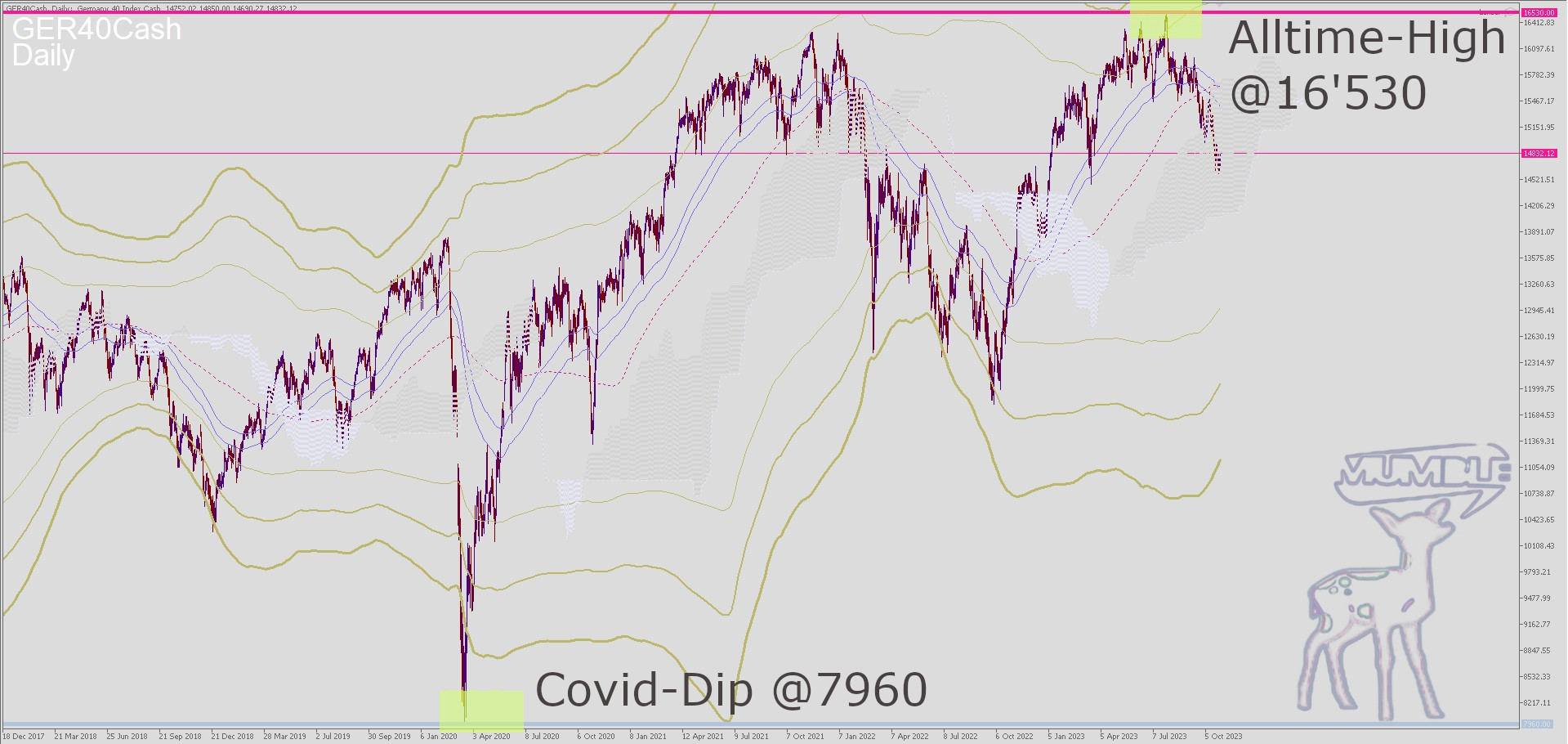
Alle drei Leitzinsentscheidungen sind dem Tenor nach unauffällig, doch dahinter verbirgt sich eine gigantische ökonomische Weichenstellung. Die Märkte sind weitestgehend resilent, können weiterhin nahe ihren Allzeithochs rangieren.
So der Deutsche-40 heute mit 14’840 Punkten 86% überhalb seines Covid-Dips bei 7’960 Punkten und lediglich 11% unterhalb seines Allzeit-Hochs bei 16’530 Punkten.
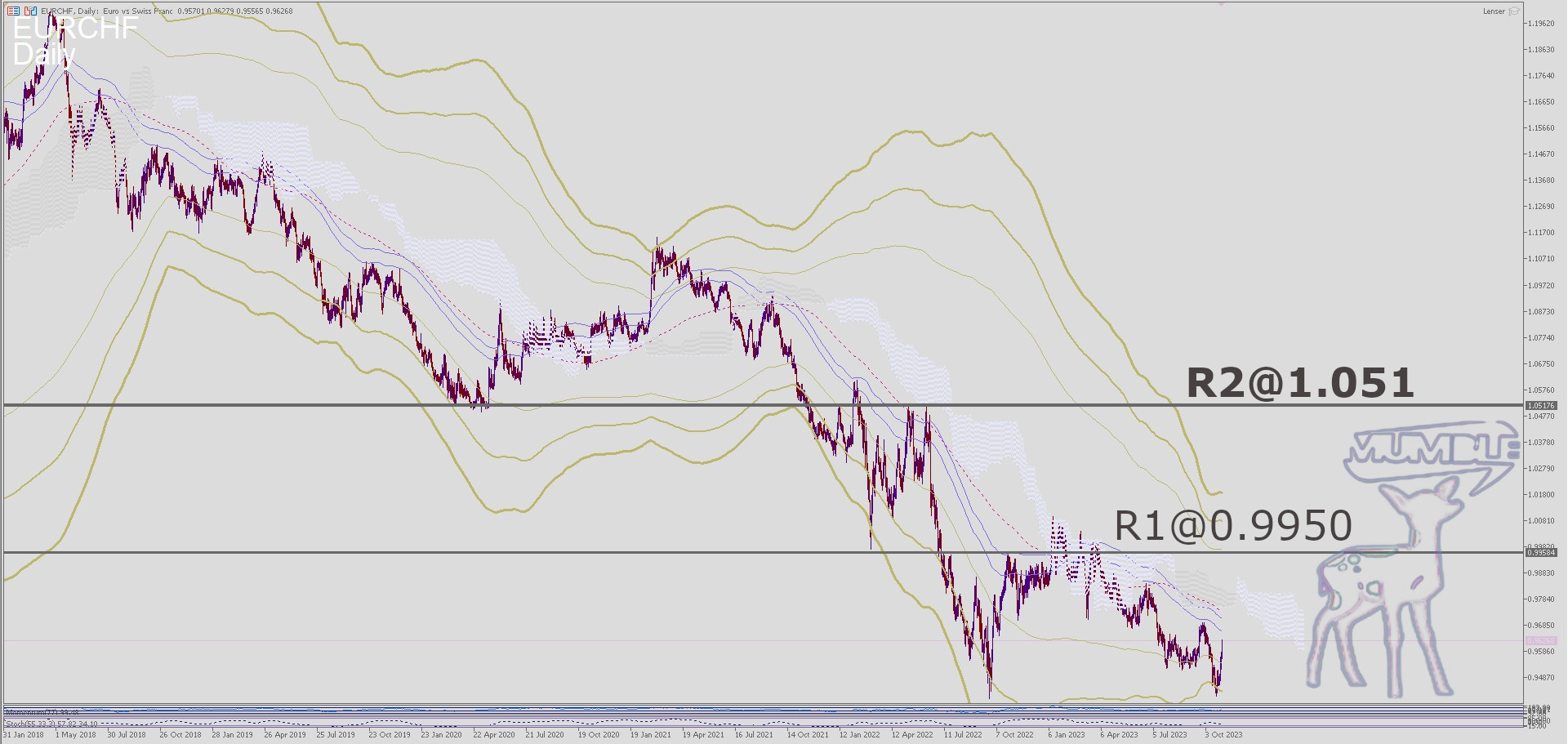
Das Risiko wandert weiter in Richtung Devisen, allen voran dem Schweizer Franken. Die Kantonswährung ist bisweilen nur noch mit Gold aufzuwiegen und scheint bis dato keine Intervention seitens der SNB befürchten zu müssen. Die Schweiz absorbiert das Value ohne dabei Schaden nehmen zu müssen, im Gegenteil, die SNB ist mittlerweile weit über dem historischen Negativleitzins bei 1.75%.
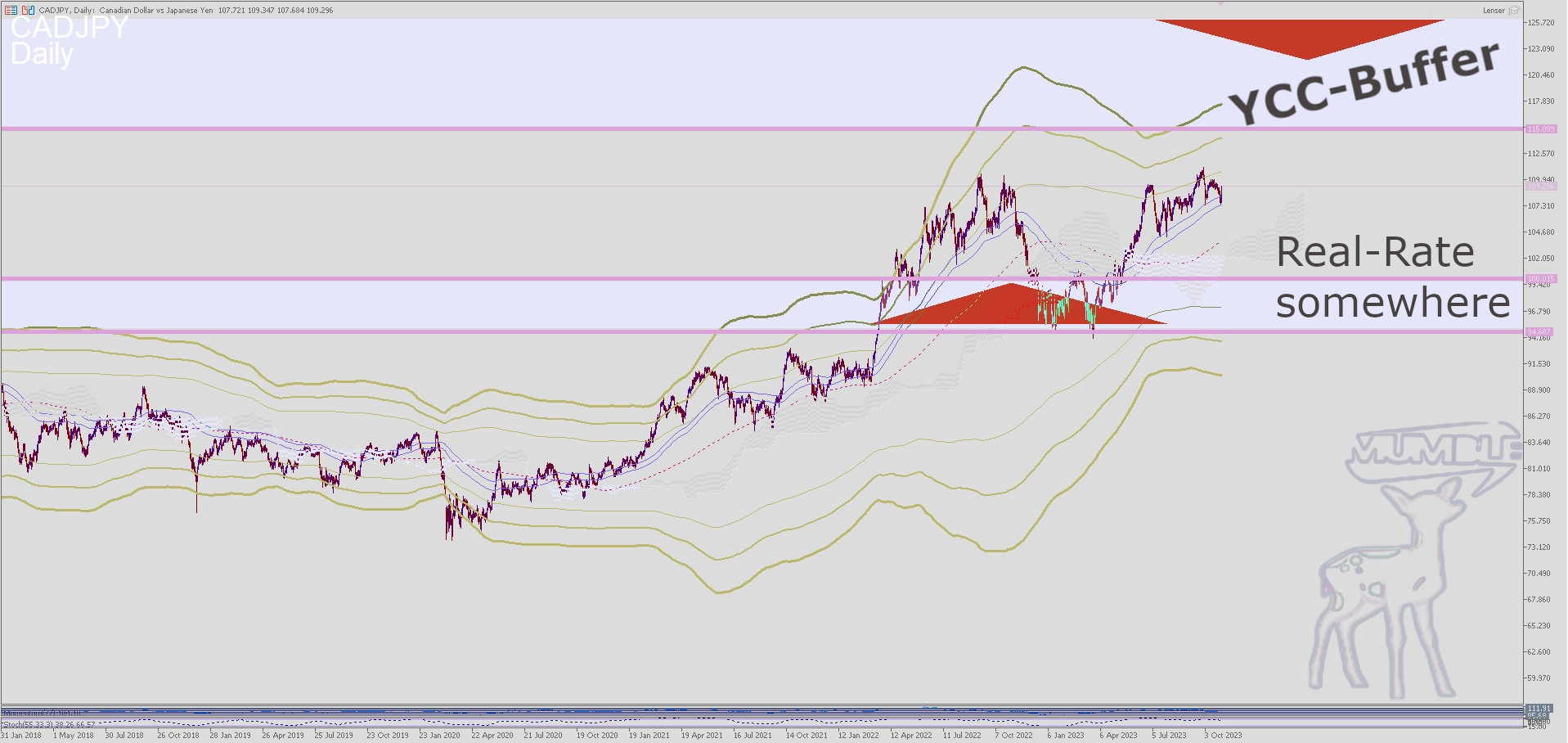
Auf die Situation in Japan nehme ich detailiert, für meine Premium-Klienten in einem Dossier, ausführlichem Trade-Setup und Live-Podcast mit Frage- und Antwortmöglichkeit, bezug.

Eine Anmerkung, bitte, in eigener Sache: BoTg-b4 BoTg-b4 kann dank vieler VorarbeiterInnen und ProgrammiererInnen (QA-Sets), endlich lernen. Sie ist natürlich kein Vergleich zu Bard oder ChatGPT, aber eine helle Freude für den Programmierer.
Botg-b4 wird unseren Nachfahren (*Bankerfaust*) aus meiner Autobiografie lesen und deren Fragen nach meinem Charakter zu meiner Sichtweise beantworten!

Weitere Details und einen Ausblick auf den FX Exchange wie immer für Premium-Mitglieder.

LG Ben

Goody Traders

English 2023-10-25, the BoC keeps its key interest rate the same at 5.00%.
2023-10-26, the ECB keeps its key interest rate the same at 4.50%.
2023-10-31, the BoJ keeps its key interest rate the same at (minus)-0.10%.


On October 7th, 2023, Tehran’s henchmen (Hamas, Hezbollah) has attacked Israeli civilians and indiscriminately lynch babies, women, young and old in the most barbaric way. These subhumans took hundreds of hostages, of which a German citizen has now lost her life.
Islam will always revert to the Middle Ages, a rusty sect, alongside which there is only one thing: non-Muslims.
Since I know that many of you rationally/logically, so to speak „humanly“ prefer an „eye for an eye“ position, the following should be mentioned:
There are 13.5 million Jews living in the world, while 1,400 Jews have been murdered on Israeli soil compared to 1,300 million Muslims. Apart from the many details and historical circumstances (which clearly speak against the ungrateful Muslims ~WW1 Muslims got back the areas of the lost Ottoman Empire with minimal loss of Israeli territory), logic dictates: 13.5M divided by 1,300M equals 0.01. For a retaliatory strike, 1,400 Israeli victims divided by 0.01 equals 140,000 retaliatory victims to mathematically settle the blood.
A declaration of war against Tehran is long overdue (rocket strikes from Gaza, Anti-Israel rethorics of the Ayatollah K.). Moscow should read the signs of the times, withdraw from Ukraine soon and offer the Western-Alliance Iran as a firststrike “compensation.” While we also know and honor that Moscow intended to secure NATO from itself, by securing the balance of power (Russian crimea A-base, tactical nuclear military base).
These sponges of a retarded religion are not allowed more than these few lines. Stand with Israel. Full stop.

The market impact of all three key interest rate decisions is unremarkable, but behind them lies a gigantic economic decision. The markets are largely resilient and can continue to be close to their all-time highs.
So the German 40 today stands at 14,840 points, 86% above its Covid dip at 7,960 points and just 11% below its all-time high at 16,530 points. The risk continues to move towards safe-heaven currencies, especially the Swiss franc. The cantonal currency can somewhat only be counterbalanced with gold and so far there does not appear to be any need to fear intervention from the SNB. Switzerland absorbs the (risk-off) value without having to suffer any damage, on the contrary, the SNB is now well above the historical negative key interest rate (-0.10) , todays count at 1.75%.
I refer to the situation in Japan in detail for my premium clients in a dossier, detailed trade setup and ongoing live podcasts with question and answer options.

A note, please, on my own behalf: BoTg-b4 BoTg-b4 now can learn thanks to many foremen and programmers (QA sets). Of course it’s no comparison to Bard or ChatGPT, but a programmer’s joy.
Botg-b4 will read my autobiography to our descendant (*Bankerfaust*) and answer their questions about my point of view!

More details and my outlook on the FX Exchange as always for Premium Members.

Sincerely Yours, Ben

DAX40__Daily
DAX40 Daily-Chart

EURCHF__Daily
EURCHF Daily-Chart

CADJPY__Daily
CADJPY Daily-Chart

CADJPY__Daily
BoTg-b4 initial

CADJPY__Daily
BoTg-b4 Happy Halloween

Externe Quellen/Links

URL-Link Beschreibung
wionews.com – ‚You and your Hamas friends…‘
tradingeconomics.com – Interest Rate country list
bankofcanada.ca – Monetary Policy Report October 2023
ecb.europa.eu – Remarks by Luis de Guindos
boj.or.jp – Statement on Monetary Policy October 31, 2023

Goody Philip Lowe

Goody Philip Lowe

2023-09-11 01h:25m:49s GMT+2

Guten Morgen,

German 2023-09-05, die RBA behält ihren Leitzins mit 4.10% gleich.
2023-09-06, die BoC behält ihren Leitzins mit 5.00% gleich.


„[…] Some further tightening of monetary policy may be required to ensure that inflation returns to target in a reasonable timeframe, but that will continue to depend upon the data and the evolving assessment of risks“, so die Bank of Australia.
Keine große Überraschung, ähnliches so denn liest sich in einem vorherigen Statement zur australischen Geldpolitik. Wir erhalten mit dem „Chartpack“ (Graphs on the Australian Economy and Financial Markets) vom 2023-09-06 einen umfassenden Überblick, zu den im zweiten Halbsatz angedeuteten „Risiken“.
Der australische Dollar ist eine klassische Commodity-Währung, welche vom Bedarf (zumeist Chinas) an Eisen-Erz, Gold, Getreide-Weizen, Kupfer, Nickel, Aluminium und Zink abhängig ist. Aber auch Energieträger wie Steinkohle (16%), Erdgas (11%) und Rohöl (1%) haben einen gewichtigen Exportanteil. Gerade das Supply aus den Goldminen kann einen Einfluss auf die Kaufkraftparität und den Exchange haben. Äußerst wichtig für den China-Anreiner ist die Weltökonomie, welche den Bedraf der Chinesen an diesen Produkten speist.
Somit ist der AUD zugleich eine Risk On/Off Währung im Sinne einer positiven Korrelation mit den Märkten. Mitte 2013 dann die direkte Intervention zur Schwächung der Exportwährung. Seither hatte das Land eine negative Handelsbilanz bis 2020 das Breakeven erreicht wurde. Mit der Covid-Pandemie und der einhergehenden Abwehrmaßnahmen, sprang das Balance-Sheet um das dreifache auf ca. 575 Billionen AUD, dafür ist das Debt/GDP vergleichsweise niedrig (25% vs Deutschland 66% vs USA 129%) und die FX-Reserven auf einem Allzeit-Hoch. Insgesamt ist der AUD keine Safe-Heaven-Währung, keine Risk-Off Flucht-Währung, aber dafür ein robustes Instrument der australischen Ökonomie. Ja und dazu sollen Währungen auch dienen, um der zugrunde liegenden Wirtschaft einen formidablen Nährboden zu schaffen.
Hut ab, Mr Lowe, Job done! Der RBA Vorsitzende gab am 2023-09-07 seine Abschieds-Rede und gibt nach regulärer 7-jähriger Amtszeit den Zentralbankvorsitz vakant.

„[…] With recent evidence that excess demand in the economy is easing, and given the lagged effects of monetary policy, Governing Council decided to hold the policy interest rate at 5% and continue to normalize the Bank’s balance sheet. However, Governing Council remains concerned about the persistence of underlying inflationary pressures, and is prepared to increase the policy interest rate further if needed“.
Die Bank of Canada mit ihrem Vorsitzenden Tiff Macklem kommt zu einer vergleichbaren Determinante und behält so ihren Leitzins weiterhin bei 5%. Auch hier schliesst man eine weitere Anhebung zur Abwehr eine Inflationsspirale nicht kategorisch aus. Eine Geldverknappung bzw. Balance-sheet Normalisierung sei bereits im Gange.

Weitere Details und einen Ausblick auf den FX Exchange wie immer für Premium-Mitglieder.

LG Ben

Goody Traders

English 2023-09-05, the RBA is keeping its key interest rate the same at 4.10%.
2023-09-06, the BoC keeps its key interest rate the same at 5.00%.


„[…] Some further tightening of monetary policy may be required to ensure that inflation returns to target in a reasonable timeframe, but that will continue to depend upon the data and the evolving assessment of risks,“ said the Bank of Australia.
No big surprise, something similar can be read in a previous statement on Australian monetary policy. With the “Chartpack” (Graphs on the Australian Economy and Financial Markets) from 2023-09-06 we get a comprehensive overview of the “risks” indicated in the second half of the sentence.
The Australian dollar is a classic commodity currency, which one depends on the demand (mostly from China) for iron ore, gold, grain wheat, copper, nickel, aluminum and zinc. But energy sources such as coal (16%), natural gas (11%) and crude oil (1%) also have an important export share. The supply from the gold mines in particular can have an influence on purchasing power parity and the exchange. What is extremely important for an economy next to China is the health of the world economy, which feeds the Chinese economy more directly and visa versa the demand for Australian export goods.
The AUD is therefore also a risk on/off currency in the sense of a positive correlation with the markets. Then in mid-2013 there was direct intervention to weaken the export currency. Since, the country had a negative trade balance until breakeven was reached in 2020. With the Covid pandemic and the associated counter measures, the central balance sheet jumped threefold to around AUD 575 trillion, but with goverment Debt/GDP comparatively low (25% vs Germany 66% vs USA 129%) and FX reserves at an all-time high, the fundamentals are in pretty good shape. Overall, the AUD is not a safe haven currency, not a risk-off escape currency, but it is a robust instrument serving its very Australian economy.
Yes, that’s what currencies are supposed to do: to create a formidable breeding ground for the underlying economy.
Respect and much Love&Spirit to Mr Lowe, job done! The RBA chairman gave his farewell speech on 2023-09-07, announcing the vacancy for the central bank chair after a regular 7-year term.

„[…] With recent evidence that excess demand in the economy is easing, and given the lagged effects of monetary policy, Governing Council decided to hold the policy interest rate at 5% and continue to normalize the Bank’s balance sheet. However, Governing Council remains concerned about the persistence of underlying inflationary pressures, and is prepared to increase the policy interest rate further if needed“.
The Bank of Canada, with its chairman Tiff Macklem, comes to a comparable determinant and keeps its key interest rate at 5%. Here, too, a further increase to ward off an inflationary spiral is not categorically ruled out. However, a tightening of the money supply, thus a normalization of the balance sheet is said to be underway.

More details and my outlook on the FX Exchange as always for Premium Members.

Sincerely Yours, Ben

Externe Quellen/Links

URL-Link Beschreibung
RBA – Statement on Monetary Policy 05 September 2023
RBA – Chart Pack
RBA – Some Closing Remarks – Philip Lowe
OEC – Australian Economy
BoC – Statement on Monetary Policy 06 September 2023
BoC – Tiff Macklem Speech, Calgary

Inflation sinkt auf 3%

Inflation sinkt auf 3%

2023-07-15 10:43:42GMT+2

Guten Morgen, auf zum Brunch

German 2023-07-12, die BoC erhöht ihren Leitzins 25 Basispunkte auf 5.00%.
2023-07-12, die US-Kerninflation sinkt auf 4.8% (exklusive Nahrungsmittel, Energie) 2023-07-12, die US-Inflation sinkt auf 3.0% (niedrigster Wert seit März-2021)

Die niedriger als erwarteten Inflations-Zahlen haben den Wind aus dem Rate-Hike-Cycle genommen. Die Märkte sehen sich mit zu teuren USD eingedeckt und reduzieren sofort ihre Bestände. Über das gesamte FX-Board hinweg, gibt der USD nach. Der USDCHF schliesst mit 0.8618 auf dem tiefsten Stand seit Januar-2015.

Weitere Details und einen Ausblick auf den FX Exchange wie immer für Premium-Mitglieder.

LG Ben

Goody Traders

English 2023-07-12, BoC raises its policy rate by 25 basis points to 5.00%.
2023-07-12, US core inflation falls to 4.8% (excluding food, energy) 2023-07-12, US inflation falls to 3.0% (lowest since March-2021)

The lower than expected inflation numbers have taken the wind out of the rate hike cycle. The markets see themselves covered with too expensive USD and immediately reduce their stocks. Across the FX board, the USD is falling. USDCHF closes at 0.8618, lowest level since Jan-2015.

More details and my outlook on the FX Exchange as always for Premium Members.

Sincerely Yours, Ben

USDCHF H4 Chart
USDCHF H4 Chart
USDX H4 Chart
USDX H4 Chart

Externe Quellen/Links

URL-Link Beschreibung
Bank of Canada – Press Con: Monetary Policy Report – July 2023
Trading Economics – Interest Rate Canada
Trading Economics – US Kerninflation
Trading Economics – US-Inflation

SVB, Silvergate gone, who’s next?

VIX – 4H-Chart Breakout-Indicator Qualifier

Guten Morgen,
German 07-März-2023, die RBoA erhöht ihren Leitzinssatz um 25 Basispunkte auf 3.60%.
08-März-2023, die BoC behält ihren Leitzinssatz um 4.50 Prozentpunkte bei.
10-März-2023, die BoJ behält ihren Leitzinssatz bei -0.1 Prozentpunkte. Gleichzeitig wird die YCC um 0.5% 10Y-Goverment Bonds verteidigt.

Die Silicon Valley Bank, Financé der hiesigen Start-Up Industrie gab am 10-März-2023 ihren Bankrott bekannt. Zwei Tage zuvor am Mittwoch 08-März-2023 fiel bereits die „Kryptowährung“-Bank Silvergate.
Vorahnungen einer erneuten Weltfinanzkrise ließen besonders die Finanztitel unter Druck geraten.

Aus gesundheitlichen Gründen verweise ich für eine ausführliche Marktbetrachtung auf den Premium-Content (Subscribers only). Die Verträge mit dem aktuellen Hosting Betreiber (MumbleFX.com) laufen noch bis in den August-2023. Aus diesem Grund wird der Free-Content-Bereich erst ab diesem Datum sein neues Erscheinungsbild veröffentlichen. Viele meiner Web-Projekte sind bereits Produktion-Ready und werden in Kürze promotet.

Weitere Details und Ausblick auf den Exchange wie immer für Premium-Mitglieder. Bünyamin

Goody Traders,
English 07-Mar-2023, the RBoA raises its policy rate by 25 basis points to 3.60%.
08-Mar-2023, the BoC keeps its key interest rate at 4.50 percentage points.
10-Mar-2023, the BoJ keeps interest rates at -0.1 percentage points. At the same time, the YCC is defended by 0.5% 10Y government bonds.

The Silicon Valley Bank, Financé of the local start-up industry announced its bankruptcy on March 10th, 2023. Two days earlier on Wednesday 08-March-2023 the „cryptocurrency“ bank Silvergate failed.
Premonitions of a new global financial crisis put banking stocks in particular under pressure.

For health reasons, I refer to the premium content (subscribers only) for a detailed market analysis. The contracts with the current hosting operator (MumbleFX.com) run until August 2023. For this reason, the free content area will not publish its new appearance until this date. Many of my web projects are already production-ready and will be promoted shortly.

More details and my outlook on the Foreign Exchange as always for Premium Members. Sincerely Yours, Ben

1. 2. 3. 4.

Entrenched around Five

bankofcanada.ca – Schedule End-of-year speech Governor Tiff Macklem
bankofcanada.ca – BoC Press Release December-07-2022
tradingeconomics.com – BoC Interest Rate
EURCAD Daily-Chart

Guten Morgen,
German Dezember-07 2022, die Bank of Canada erhöht ihren Leitzinssatz wie zuvor Ende Oktober, um 25 Basispunkte auf nunmehr 4.25%. Governor Tiff Macklem wird Dezember-12 vor die Presse treten und dazu Rede und Antwort liefern.
Die Presse Veröffentlichung zur Leitzinserhöhung liest sich wie folgt: Wirtschaftswachstum, geringe Arbeitslosigkeit aber überhöhte Inflation. Der Absatz in den Konsum- und Immobilienmärkten schrumpft, was die Zentralbank zur einer wenig euphorischen Wirtschaftsprognose für die kommenden zwei Jahresviertel bewegt.
Die Kerninflation, gemessen an einem Korb häufig akquirierter Konsumgüter, verliert an steigendem Momentum und war die vergangenen drei Monate gar im Fallen begriffen. Neben einer Verteuerung des kanadischen Dollars, nutzt das Team um den Vorsitz Tiff Macklems‘ auch eine Verknappung des Geldes. Das Gegenmittel zum Quantitative Easing, eben dies des Quantitative Tightening, unterstützt die Leitzinspolitik bei der Bekämpfung der erhöhten Inflation.
Der kanadische Doller zeigt sich im Exchange äußerst defensiv, verliert die letzten fünf Wochen (KW45) gute 7% gegenüber dem Euro. Ein erster Widerstand zeigt sich bei 1.485 EURCAD. Der nun gesicherte Absatz kanadischer Raffinerie-Produkte dürfte es dem Paar erschweren, sehr weit über dieses Level zu steigen.

Weitere Details und Ausblick auf den Exchange wie immer für Premium-Mitglieder. Bünyamin

Goody Traders,
English December-07 2022, the Bank of Canada raises its benchmark interest rate by 25 basis points to 4.25%, as before at the end of October. Governor Tiff Macklem will address and answer the press December-12.
The press release on the interest rate hike reads as follows: Economic growth stable, low unemployment but excessive inflation. Sales in the consumer and real estate markets are shrinking, prompting the central bank to issue a less than euphoric economic forecast for the next two quarters.
Core inflation, as measured by a basket of most acquired consumer goods, is losing rising momentum and has actually been falling for the past three months. In addition to an appreciation of the Canadian dollar, the team chaired by Tiff Macklems is also taking advantage of the effects when shrinking their central bank balance sheet. The antidote to quantitative easing, namely quantitative tightening, supports the key interest rate policy in combating increased inflation.
The Canadian dollar is extremely defensively traded in the exchange, losing a good 7% against the euro in the last five weeks (week 45). A first resistance appears at 1,485 EURCAD. Now geopolitically secured sales of Canadian refinery products should make it difficult for the pair to pin point very far above this level.

More details and my outlook on the Foreign Exchange as always for Premium Members. Sincerely Yours, Ben

エイネン・ワンダーヴォレン・ナハミタッグ
Japanese 2022 年 12 月 7 日、カナダ銀行はベンチマーク金利を 25 ベーシス ポイント引き上げて 4.25% にしました。 12 月 12 日、ティフは記者会見で話します。
利上げに関するプレス リリース:
ほとんどの購入された消費財のバスケットで測定されるコアインフレ率は勢いを失い、実際には過去3か月で低下しています.
カナダドルは取引所で非常にディフェンシブに取引されており、実際、過去 5 週間 (第 45 週) でユーロに対して 7% 下落しています。 最初のレジスタンスは 1,485 EURCAD です。 地政学的にカナダ製油所製品の販売が確保されているため、ペアがこのレベルを大幅に超えることは難しいはずです。

Premium の外国為替取引所の詳細と見通し ベンジャミン

Goedemorgen,
Dutch December-07 2022, de Bank of Canada verhoogt haar referentierentetarief met 25 basispunten tot 4,25%, net als eind oktober. Gouverneur Tiff Macklem zal de pers toespreken en beantwoorden op 12 december.
Het persbericht over de renteverhoging luidt als volgt: Economische groei stabiel, lage werkloosheid maar hoge inflatie. De verkopen op de consumenten- en onroerendgoedmarkt lopen terug, wat de centrale bank ertoe bracht een weinig euforische economische prognose voor de komende twee kwartalen af te geven.
De kerninflatie, gemeten aan de hand van een mandje van de meest gekochte consumptiegoederen, verliest aan momentum en is de afgelopen drie maanden zelfs aan het dalen. Naast een appreciatie van de Canadese dollar profiteert het team onder leiding van Tiff Macklems ook van de effecten bij het verkleinen van hun centralebankbalans. Het tegengif voor kwantitatieve verruiming, namelijk kwantitatieve verkrapping, ondersteunt het belangrijkste rentebeleid in de strijd tegen de toegenomen inflatie.
De Canadese dollar wordt extreem defensief verhandeld op de beurs en verloor de afgelopen vijf weken (week 45) maar liefst 7% ten opzichte van de euro. Een eerste weerstand verschijnt bij 1.485 EURCAD. Nu de geoplotisch beveiligde verkoop van Canadese raffinaderijproducten het voor het paar moeilijk zou moeten maken om ver boven dit niveau te komen.

Meer details en vooruitzichten op de forex-uitwisseling zoals altijd voor Premium leden. Benni

Günaydın,
Turkish 07 Aralık 2022, Kanada Merkez Bankası gösterge faiz oranını Ekim sonunda olduğu gibi 25 baz puan artırarak %4,25’e yükseltti. Vali Tiff Macklem 12 Aralık’ta basına hitap edecek ve cevap verecek.
Faiz artırımına ilişkin basın açıklaması şu şekilde: Ekonomik büyüme istikrarlı, düşük işsizlik ancak yüksek enflasyon. Tüketici ve gayrimenkul piyasalarındaki satışların daralması, merkez bankasının önümüzdeki iki çeyrek için pek de coşkulu olmayan bir ekonomik tahmin yayınlamasına neden oluyor.
En çok satın alınan tüketim mallarından oluşan bir sepetle ölçülen çekirdek enflasyon, yükselen ivmesini kaybediyor ve aslında son üç aydır düşüyor. Kanada dolarının değer kazanmasına ek olarak, başkanlığını Tiff Macklems’in yaptığı ekip, merkez bankası bilançosunu küçültmenin etkilerinden de yararlanıyor. Niceliksel gevşemenin panzehiri, yani niceliksel sıkılaştırma, artan enflasyonla mücadelede temel faiz oranı politikasını desteklemektedir.
Kanada doları, son beş haftada (45. hafta) euro karşısında %7’lik iyi bir kayıpla forex borsada son derece savunmacı bir şekilde işlem görüyor. İlk direnç 1.485 EURCAD’de görünüyor. Şimdi, Kanada rafineri ürünlerinin jeopolitik kolay satışları olmasılı verenden, paritenin bu seviyenin çok üzerine çıkmasını zorlaştırmalıdır.

Premium aboneler için her zaman olduğu gibi Exchange hakkında daha fazla ayrıntı ve görünüm. Sizin Bünyamin

The Buck leads the way (down)

bankofcanada.ca/ – Bank of Canada
tradingeconomics.com/ – Canada IR
snb.ch – SNB WebTV
CADCHF 30-Minute Chart

Guten Morgen,
German Tiff Macklem erhöht den kanadischen Leitzins um lediglich 50 Basispunkte, statt derer anberaumten 75. Die Märkte missinterpretieren dies als bullishes Signal, als Zeichen dafür, von Rezessionsmodus direkt in die nächste Hausse umschalten zu können. Der Hintergrund für die niedrigere Leitzinserhöhung liegt aber nicht in der erfolgreich umfassten Inflation. Diese beginnt erst gerade eine Eigendynamik auszubilden, stehen doch Lohnerhöhungen vollends aus. Die Franzosen gehen wie gewohnt als Erste auf die Straßen und fordern die überfälligen Inflationsausgleichszahlungen von Seiten ihrer Arbeitgeber. Diese sind eigentlich unumgänglich, um den Konsum und damit den Absatz in der Realwirtschaft aufrecht zu erhalten.
Nein, der Grund für eine moderatere Leitzinserhöhung liegt in der von Macklem direkt ausgesprochenen Befürchtung, mit einer zu schnellen Erhöhung die Rezessionsgefahr, eine Abwärtsspirale zu befeuern.
BoC 26-10-2022 +50bp (3.25 -> 3.75).
Das FX-Board zeigte deutlich, dass eine höhere Leitzinserhöhung objektive betrachtet sinnvoller gewesen wäre. Der kanadische Dollar musste teilweise nachgeben, die Marktteilnehmer gaben eine Portion ihre Longs auf den Buck auf.

Die Schweizer Nationalbank lässt mit weiteren geldmarktpolitischen Mediengesprächen (Pressekonferenzen) auf sich warten. Diese waren auf der vergangenen Veranstaltung am 22.September anberaumt worden. Wir sind nach wie vor sehr gespannt auf deren Vorträge und Antworten.

Ein nicht gewählter Rishi Sunak wurde gestern, 26.Oktober, als neu eingesetzter Prime Minister im House of Commons vorstellig. Das britische Pfund konnte daraufhin wieder etwas an Boden gutmachen.

MumbleFX Dashboard wird größer als erwartet. Die gewonnen Daten sind wichtig genug, um diese direkt mit Premium auf der Webseite einzubinden. Dash an und für sich, wird auf weitere Plattformen erweitert. Momentan läuft das Programm lediglich mit MetaTrader4/5. Mit der Einbindung via Premium aber, wird eine API angeboten, damit Klienten auch ohne Trading-Software auf die von Dash generierten Informationen zugreifen können.
Ein Webcast-Video ist in Arbeit, um wie angekündigt die EA-Optimierung eines Bollinger Band-Indikators zu erläutern.

Weitere Details und Ausblick auf den Exchange wie immer für Premium-Mitglieder.
Bünyamin

Goody Traders,
English Tiff Macklem raises Canada’s interest rate by just 50 basis points instead of the planned 75. The markets misinterpret this as a bullish signal, a sign that they can switch from recession mode directly to the next bull market. However, the reason for the lower interest rate hike is not the successfully contained inflation. This is just beginning to gain momentum of its own, as wage increases are still pending. As usual, the French are the first to take to the streets and demand overdue inflation compensation payments from their employers. These are actually unavoidable in order to maintain consumption and thus sales in the real economy.
No, the reason for a more moderate interest rate hike is Macklem’s fear, directly expressed, that if the rate were raised too quickly, the danger of recession could be fueled by a downward spiral.
BoC 26-10-2022 +50bp (3.25 -> 3.75).
The FX Board clearly showed that a higher rate hike would have made more sense from an objective point of view. The Canadian dollar had to weaken in part, as market participants gave up a portion of their longs on the buck.

The Swiss National Bank has not held any further media talks (press conferences) on money market policy. These were scheduled at the previous event on September 22nd. We are still very excited about their presentations and answers.

An unelected Rishi Sunak made his appearance as the newly installed Prime Minister in the House of Commons yesterday, October 26. The British pound was then able to regain some ground.

MumbleFX Dashboard is getting bigger than expected. The data obtained is important enough to integrate it directly with Premium on the website. Dash itself will be expanded to other platforms. At the moment the program runs only with MetaTrader4/5. However, with the integration via Premium, an API will be created so that clients can also access the information generated by Dash without any trading software.
A webcast video is in the works to explain the EA optimization of a BollingerBand indicator as announced.

More details and my outlook on the Foreign Exchange as always for Premium Members.
Sincerely Yours, Ben